


Across this series, three findings have stacked on top of each other.
The $27 billion compliance figure is real but contested, and the more revealing question is not how much accreditation costs in aggregate but how the cost is distributed. The shadow org chart that activates during every reaffirmation is staffed by people whose accreditation work appears nowhere in their job description. And the labor cost is regressive — falling hardest on the institutions least equipped to absorb it.
Underneath all three findings is a single mechanism: accreditation labor stays expensive because it stays invisible.
This post is about what the research now shows when institutions actually look.
The Burnout Data Is No Longer Speculative
For years, the link between accreditation labor and faculty wellbeing was anecdotal — the kind of thing department chairs said quietly in meetings but rarely appeared in published research. That is no longer the case.
The Healthy Minds Network’s 2022–23 faculty and staff survey, conducted across eight four-year institutions and eight community colleges with more than 1,000 respondents, found that 64 percent of faculty reported feeling burned out because of work — 30 percent somewhat, 19 percent to a high degree, and 15 percent to a very high degree. Burnout was higher among women (69 percent) and gender minority faculty (71 percent) than among men (57 percent), and higher at four-year institutions (68 percent) than at community colleges (54 percent).
What’s striking is what the more granular research shows about the source of that burnout.
A 2025 narrative review in the Journal of Educational and Developmental Psychology, covering 20 peer-reviewed studies, names excessive workloads and administrative demands among the leading contributors to faculty burnout. The administrative load it describes includes accreditation processes, committee work, and institutional reporting, and it sits alongside job insecurity and emotional exhaustion.
In Inside Higher Ed’s 2022 survey of 178 chief academic officers, 59 percent of provosts said faculty feel very engaged with their work, but they voiced concern that faculty do not feel supported by or connected to the administration. About half (51 percent) neither agreed nor disagreed that their institution had taken concrete steps to address faculty burnout. Provosts see the support gap, and about half stop short of saying their institution has responded to it.
The Staff Side Is Even Less Studied
Most burnout research in higher education has historically centered faculty. The administrative and professional staff who carry the shadow org chart, which include institutional researchers, assessment coordinators, registrar staff, accreditation liaison officers, financial aid administrators — have been comparatively under-researched, despite doing some of the most acute compliance labor.
That is starting to change. A 2024 paper in Perspectives: Policy and Practice in Higher Education surveyed 335 professional services staff at UK universities, and Times Higher Education and Inside Higher Ed both reported on it. The author, Kelli Wolfe, describes burnout among administrative staff as a broad, cross-sector issue that has received little research attention. More than half of respondents regularly worked more than ten hours a day, and 59 percent worked during scheduled annual leave. Gail Kinman, a visiting professor of occupational health psychology who commented on the findings, said these staff keep the institution running and that their work “can be invisible.”
The visibility problem is not metaphorical. It is structural.
When a faculty member spends 200 hours on accreditation work, those hours are at least nominally captured in service expectations — even if they’re not properly compensated. When a staff member in the registrar’s office spends 200 hours pulling student-level data for an evidence inventory, those hours are simply absorbed into “regular duties,” with no record of the displacement.
What the Newest Compliance Research Is Showing
The State Authorization Network’s 2026 report, cited earlier in this series, covers one compliance domain: professional licensure.
In a survey of 228 respondents at SAN member institutions, 85 percent reported a moderate or significant increase in compliance workload following the 2024 federal certification rules. About two-thirds added between one and ten staff hours per week, and 12 percent added 21 or more during peak implementation. Only 22 percent of institutions hired additional staff, and 55 percent did not, so most of the added work landed on existing roles. The report says the burden is particularly acute at smaller institutions and those without dedicated compliance resources, and it notes that institutions with heavier burdens may have been more likely to respond.
That is one regulatory domain. Accreditation, regional and programmatic, sits alongside it, along with Title IX, Clery, financial aid verification, state authorization, and the other compliance regimes higher education has accumulated over the past two decades.
The FAFSA verification study referenced in Post 3 (Guzman-Alvarez and Page, 2021, using 2014 data) estimated that community colleges spend 22 percent of their financial aid office operating budget on verification, compared with 15 percent at public four-year institutions and 1 percent at private four-year institutions. That is roughly twenty-two times the private four-year rate on a single federal compliance task.
Taken together, these sources show compliance work spread unevenly across institution types, layered onto existing staff, and reported alongside burnout and intent to leave.
What Has Changed
Two things have changed in the last few years that make the labor invisibility harder to maintain.
The first is that the data is catching up.
Five years ago, an honest conversation about accreditation labor relied largely on anecdote. Today, there are peer-reviewed studies, multi-institution surveys, accreditor-sector reports, and dissertations specifically examining the personnel cost of compliance.
The question is no longer whether the labor is real. The question is whether institutions and accreditors are willing to act on what the data already shows.
The second is that the workforce is no longer stable enough to absorb invisible labor indefinitely.
The TimelyCare survey of more than 500 faculty and staff at U.S. four-year and two-year institutions found that 53 percent have considered leaving their jobs due to burnout and increased workload. The contingent faculty population, which now makes up roughly 68 percent of U.S. faculty appointments, has minimal institutional incentive to absorb accreditation labor without compensation.
What has held the system together for the last two decades is institutional norms and the goodwill of the people doing the work. Both of those resources are running low.
Where AI Fits
AI enters this conversation as a proposed response to the workload problem. The evidence for what AI can do is thinner than the evidence for the problem, so it helps to separate what the sources support from what they leave open.
The JEDP review lists AI-driven automation of grading, feedback, and monitoring among the ways to reduce faculty workload, and calls the technology underused but promising. The same paper says the role of technology in burnout is underexplored and needs more study. It also flags transparency, bias, and data security as issues institutions have to address. The research it draws on, a 2019 systematic review by Zawacki-Richter and colleagues, found AI in higher education used mostly for administrative tasks, student support, and predictive analytics, with few studies of pedagogical or ethical implications. The research base shows AI aimed at administrative work and says little so far about whether it reduces burnout.
Accreditors have started to address its use. Middle States adopted a Use of Artificial Intelligence Policy and Procedures that took effect July 1, 2025, and describes it as reflecting the Commission’s commitment to innovation. Practitioners are already reporting uses. A recap of an MSCHE annual conference describes how AI can be used to tag, classify, and map evidence across the standards, and to detect gaps and draft summaries.
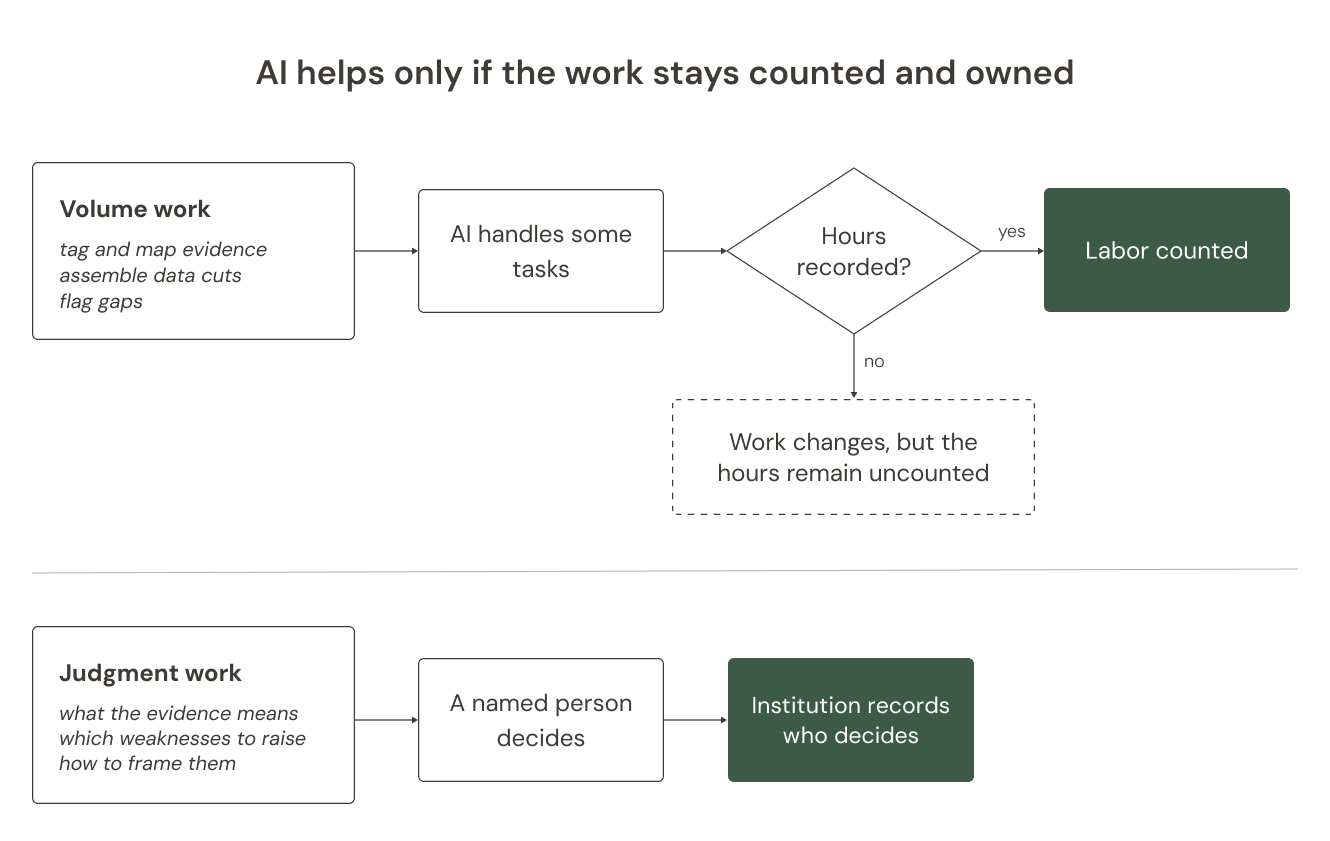
Parts 2 and 3 drew the line between volume work and judgment work. The narrative above adds a different consideration: much of the added load lands on existing roles without being counted. An AI tool that takes over some of those hours helps the people carrying them, but only if the institution also records what was taken over and who still decides what the evidence means. Otherwise the labor moves into a tool and stays uncounted.
Where the Findings Leave Us
Across this series, every research source has pointed in the same direction. Accreditation produces real value — the framework matters, the protections it offers students are meaningful, the continuous-improvement work it structures is consequential. None of the findings examined here argue against accreditation as a system.
What they argue is that the labor required to sustain that system is no longer a resource institutions can draw on without counting.
It has been counted, by burnout researchers, by compliance survey teams, by institutional researchers studying their own workloads, by accreditor-sector reports, and by the people quietly leaving their jobs after reaffirmation cycles end.
The labor was always there. What’s new is that it is finally visible. The question for the next decade is what institutions, accreditors, and the broader higher education ecosystem do with what the data has surfaced.
This concludes our 4-part series on the real labor cost of accreditation in higher education.
