


If you’ve sat through more than a handful of conversations about accreditation reform, you’ve heard the number.
$27 billion a year in federal regulatory compliance costs across U.S. higher education, with roughly $3 billion of that attributed to regional accreditation alone.
The figure comes from a 2015 Boston Consulting Group study commissioned by Vanderbilt University, and in the decade since it has done remarkable work. It’s been quoted in congressional testimony, pulled into op-eds, leaned on by every think tank with a position on higher ed regulation, and treated, more or less, as settled.
It is not settled.
And the fact that it has been treated as settled for ten years tells you something important about how higher education talks about its own labor.
The figure, and the pushback
The original BCG/Vanderbilt study sampled 13 institutions and extrapolated to the sector. It found that regulatory compliance represented 3 to 11 percent of core university operating expenses at the studied institutions, and that faculty and staff spent between 4 and 15 percent of their time on compliance activities.
From there, the study estimated roughly $17 billion in non-research higher-education compliance, $10 billion in research-related compliance, and inside that total, $3 billion for regional accreditation and another $3 billion for programmatic.
The pushback came almost immediately.
Belle S. Wheelan, then-president of the Southern Association of Colleges and Schools Commission on Colleges, and Mark A. Elgart of AdvancED published a sharp essay in Inside Higher Ed arguing that the headline figures were “significantly inflated as well as irresponsibly misleading.”
Their case had two parts.
First, much of what the study counted as accreditation cost was actually federal research-grant compliance — a separate regulatory regime that happens to overlap with accreditation timelines.
Second, they argued that genuine accreditation activity is “part of regular faculty service and committee work” that contributes to institutional improvement regardless of whether an accreditor exists.
Wheelan and Elgart pointed to a different number: across three accreditation regions, the average combined direct and indirect cost of accreditation at doctorate-granting research universities came out to roughly $415,000 per institution over the full review cycle.
That is not nothing.
It is also nowhere near the per-institution figure the $3 billion sector estimate implies.
So which number is right?
They’re both right, and that is the problem.
Here's the uncomfortable truth: both estimates are defensible, because they're answering different questions.
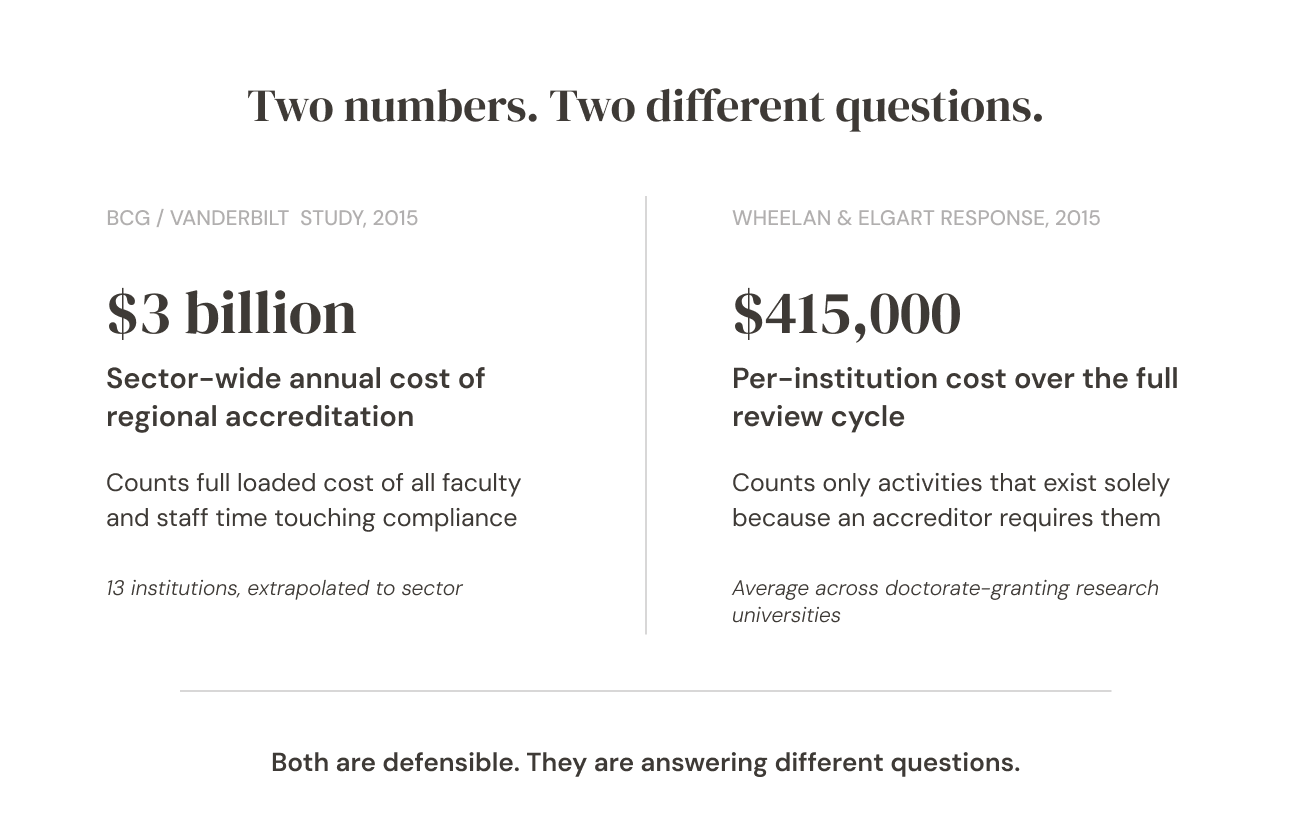
The Vanderbilt study counted everything an institution spends on activities that touch federal compliance, including faculty and staff time valued at full loaded cost. That methodology produces a big number because faculty and staff time is a big number when you actually count it.
Wheelan and Elgart’s framing counted only the activities that exist solely because an accreditor requires them — the marginal cost of accreditation, separate from work that institutions would do anyway.
You can argue all day about which framing is more honest. What you cannot argue is that either figure settles the question for the people doing the work. Because here’s what neither one tells you: how the cost is distributed inside the institution.
A $415,000 cycle cost at a research university sounds manageable in budget terms. Spread across a five-to-ten-year reaffirmation cycle, it is.
But that figure says nothing about whether the assistant provost coordinating the self-study is doing it on top of a full administrative load.
It says nothing about whether the institutional research office gets backfill for the analyst pulled into evidence prep for nine months.
It says nothing about whether the department chairs absorbing program-level documentation are getting course releases or just gratitude.
This is the gap that the entire $27 billion debate has been talking past.
The argument has been pitched, for a decade, as a referendum on whether accreditation is “too expensive” in aggregate.
The more interesting question — and the one that actually predicts whether a reaffirmation cycle will damage an institution — is whether the distribution of the cost is sustainable for the specific humans absorbing it.
That question has been almost completely absent from the policy conversation, and the people who could answer it most precisely are also the people too busy carrying the load to write about it.
What the more recent data adds
The 2015 Vanderbilt figures are now a decade old, and the regulatory environment has only thickened since.
The State Authorization Network’s 2026 report Between the Lines, Behind the Work offers a more current window into one slice of the load.
Eighty-five percent of institutions reported a moderate or significant increase in licensure compliance workload under newer federal certification requirements.
Nearly three-quarters added between one and ten staff hours per week.
Twelve percent added 21 or more hours weekly — the equivalent of a half-time hire’s worth of new work, often with no half-time hire to do it.
That is a single compliance domain at a single staffing level.
It does not include faculty time, IT coordination, cross-departmental meetings, or the cascading effect on other priorities those hours displace. Multiply across the full accreditation and compliance landscape, and the labor question gets sharper, not vaguer.
What the number was always for — and what the next decade will ask of it
The $27 billion figure has been useful precisely because it is big and quotable.
It moved the conversation.
It got accreditation onto agendas it would not otherwise have reached. That has value, even if the number itself is contested.
But a decade in, the figure has become a stand-in for a conversation we are not actually having.
The real question was never “is accreditation too expensive in aggregate.” It was always “who, specifically, is paying for it, and is the load distributed in a way the institution can sustain.”
That question matters more now than it did in 2015, for a reason that hasn’t fully landed in the policy literature yet.
The same decade that produced the $27 billion debate also produced a new generation of tools — large language models, agentic systems, document-aware AI — that are genuinely good at exactly the kind of work the shadow labor of accreditation consists of: reading, summarizing, mapping, evidence aggregation.
Whether and how those tools belong inside accreditation work is a real question, and one we’ll come back to later in this series.
But it cannot be answered honestly until the labor itself is honestly counted.
You cannot redesign work you cannot see.
