


On July 28, 2026, we ran the second module of our Roundtable Series: a small, practitioner-led conversation about how to build agentic AI workflows that hold up inside accreditation work, and specifically inside Assurance of Learning (AoL).
The cohort was deliberately small, but brought together faculty and assessment leaders from several institutions, giving us the range of perspectives we were hoping for.
An hour of conversation produced more usable insight than a week of desk research. We are writing it down here, not only for us, but for you.
Objective of the roundtable
Our core objective hasn’t changed since Module 1: we are learning a lot through our internal research, but nothing compares to hearing directly from the people living inside the process day to day.
What did change was what we brought to the table.
Since Module 1, we have been actively building alongside listening. This session was less about asking for pain points and more about putting our working assumptions in front of leaders who could stress test them against real-world experience.
We set out to get two things:
An honest reaction to the solution we are shaping.
A clear sense of whether the underlying framework is something institutions could apply to their own work—with or without us.
We built dedicated check-in points into every section of the agenda for exactly this reason. As we noted at the top of the session: the parts where participants push back are the parts where we learn the most.
Keeping the human in the loop through intentional design
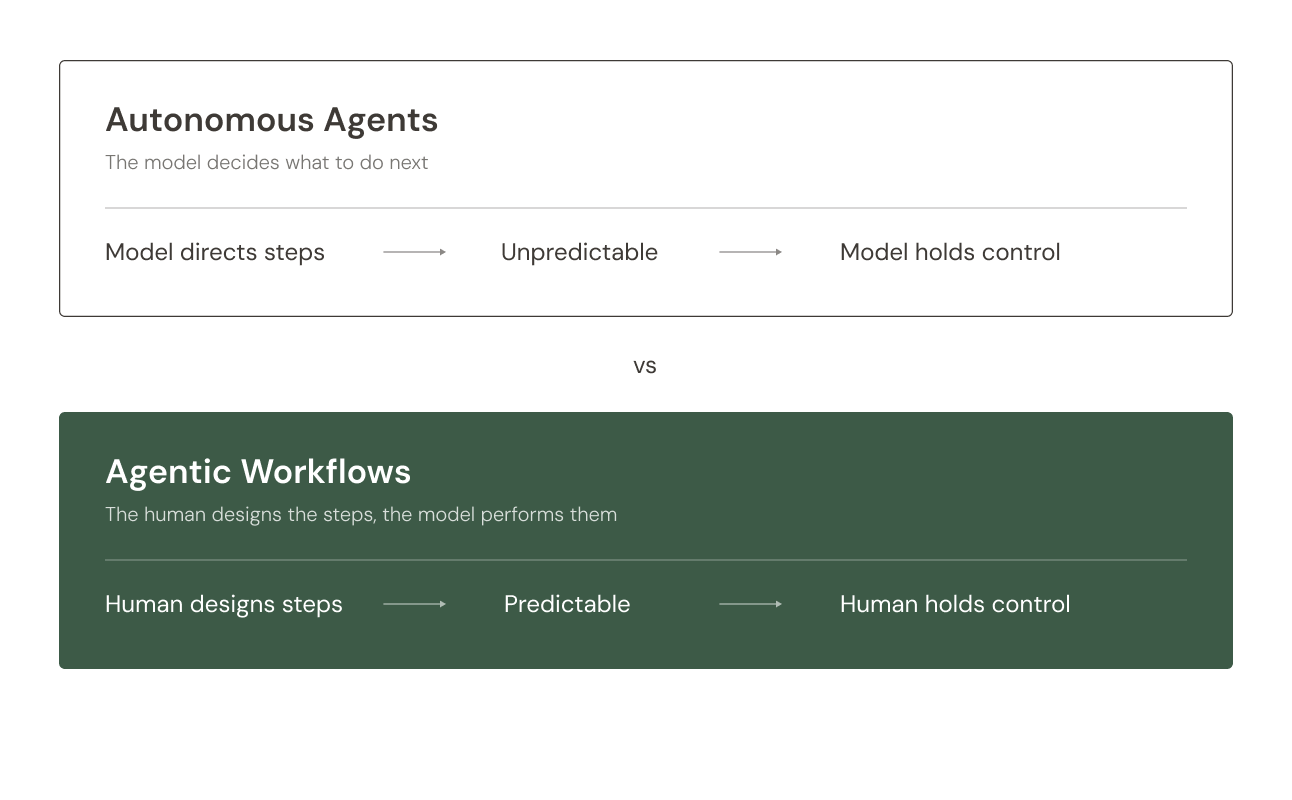
Most current excitement around agentic AI focuses on autonomous agents—where the model directs its own steps, decides what to do next, and loops continuously until it considers the task complete.
That capability is genuinely impressive.
It is also flexible, open-ended, and unpredictable because the autonomy sits with the model.
What we are building instead is an agentic workflow, where human practitioners design the steps and the model executes them. It is fixed, consistent, and predictable—putting the human in full control.
Our reason for this distinction is simple: Assurance of learning is already a designed process.
It has deliberate steps, deliberate checkpoints, and human judgment placed at specific points—because at the end of the day, a peer review team will ask you to defend each decision.
We start with a fixed workflow not because AI models lack capability, but because human control is built into AoL as a feature. Our job is to amplify that control, not route around it.
This sharpens our primary question: It is not whether AI can do accreditation, but which specific parts of the loop it can genuinely assist with.
Large language models excel at digesting large volumes of text. Reading a hundred student artifacts against a rubric is a textual understanding problem; surfacing patterns across those scores is a textual understanding problem.
When we surveyed participants before the session on where they saw the best fit, their answers landed on those exact areas:
Curriculum mapping
Artifact evaluation
Pattern and gap analysis
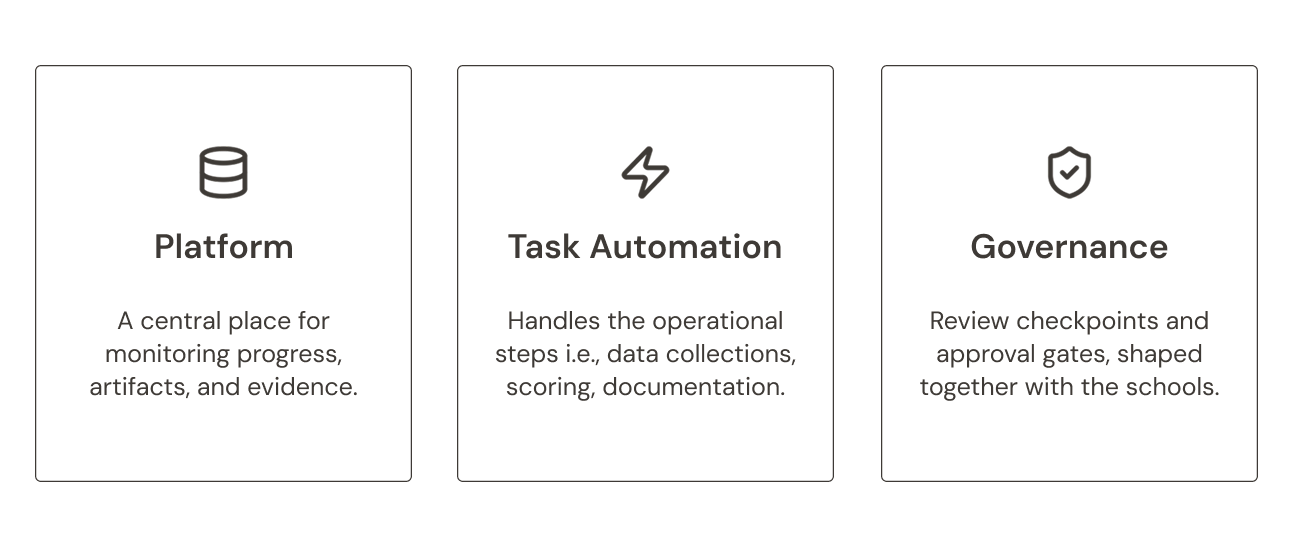
The Caveat: The rest of the process still needs somewhere to run, and it requires robust governance to remain responsible and compliant. AI provides neither out of the box. That reality shapes the three pillars we build around: a unified platform, task automation, and governance.
A first look at the platform, with artifact scoring as the use case
We walked the room through a static mockup of the platform, built around the learning goal as the unit of monitoring, with three views: university, program, and learning goal. Each learning goal moves through setup, baseline, gap analysis and intervention, and remeasure, and then closes the loop.
We then demonstrated the scoring prototype live:
The Scorer: Reads the rubric and student artifact, scores each criterion, and provides its reasoning alongside citations of the specific passages relied upon.
The Critic: A second model audits those scores, evaluating if any judgment is contestable between adjacent rubric levels. If so, it flags the criterion for human review.
Human-in-the-Loop: Criteria that AI shouldn’t judge are routed to a human before scoring begins. Reviewers can override any score, and both the override and its rationale are saved for the final report.
The Feedback That Stood Out
The questions raised during the demonstration underscored why we host these roundtables in the first place:
Reporting Integration: Participants asked whether indirect measures could sit alongside direct ones, and if results could auto-populate the updated Table 5-1 spreadsheet under the 2026 AACSB standards. Both are on our roadmap.
Timing & Process Interference: The hardest question focused on timing: If a program is mid-cycle with artifacts already under evaluation, how do you introduce AI without clouding the results? As one participant noted, introducing AI is itself an intervention that must be documented. Our current approach is to adapt to your existing timeline — taking your current curriculum map as a fixed input.
Rubric Clarity: Someone asked whether the AI defines what exceeds, meets, does not meet, or absent mean, or if humans do. The answer is that the rubric must define them. One participant shared that while their rubric lists performance levels, it has never explicitly defined them. If exceeds isn’t defined, neither five faculty members nor an AI model can apply it consistently. Getting “AI-ready” requires foundational rubric clarity first.
Governance as a condition of adoption, not an afterthought
Governance came up on its own well before we got to it on the agenda, which tells you something about where it sits for practitioners.
The question was about data security, and it came in operational terms: institutions have internal processes that any external agent has to clear before it goes anywhere near student work.
We treat governance as a foundational pillar rather than a final compliance audit because it belongs in the design phase. Agentic solution design cannot treat governance in isolation. Review checkpoints, approval gates, and audit trails are architectural decisions that must be considered alongside adoption.
Because standards and institutional requirements vary across campuses, governance frameworks must be co-designed directly with the schools using them.
Where we are headed
Module 3, planned soon, goes deep on exactly this: the governance and guardrails that have to be in place for a workflow like this to actually be adopted inside an institution.
If you want to test these concepts against a real workflow at your institution, we welcome exploratory conversations. We are building the solutions in the open, with faculty, assessment directors, and accreditation leads, and these sessions are where the building actually happens.