


We recently concluded our webinar on June 10, 2026, where we held the first session the Roundtable Series: a small, practitioner-led conversation about how agentic AI can be leveraged in accreditation, particularly Assurance of Learning (AoL). Our cohort was extremely small, but spread across two institutions in the United States and Canada, which gave us a diverse perspective. An hour of conversation led us to various insights, which we noted down not only for us, but for you as well.
Purpose of the Roundtable
While we are discovering a lot through our own research, nothing compares to hearing it from the people living inside the process on a day to day basis.
We wanted to hear their voices, and make the session as conversational as possible.
Faculty Engagement as the #1 Hurdle
One of the questions we really wanted to understand was which part of the whole AoL process takes the most amount of time. As we have been exploring the role of AI in accreditation, this one was crucial for us to see whether there was a fit.
To our surprise, two practitioners without a flinch named faculty engagement as the biggest hurdle.
What's interesting to us is decoding why faculty engagement is the hurdle. Is it because the process is too tedious? Is it because of the additional work? Or because of the hidden responsibilities?
From our research, we discovered that the additional responsibilities are what weigh on faculty and keep them from engaging with the accreditation process in a meaningful way. The indirect consequence of this is that AI can be leveraged to ease some parts of the process, making AoL more efficient and smoother.
Understanding Agentic AI
What followed was the team clearly defining the capabilities of Agentic AI, and how it differs from the standard GenAI LLMs that are more commonly used.
Agentic AI works differently from GenAI. It goes a step beyond answering to a prompt, it can take a goal, plan out the steps, use tools like files, databases, or APIs, and keep working through the task in a loop until the goal is met.
One analogy from the session that stuck with us while thinking about Agentic AI: if generative AI is the engine, then agentic AI is the whole car, and it can run several of those engines at once.
Where it Fits in Accreditation, particularly in the AoL process
After establishing the definition and capabilities of Agentic AI, the team then explained all the parts of the process in AoL to explore of parts where Agentic AI can be a good fit and parts where it can’t.
The steps pointed out in the session were the following:
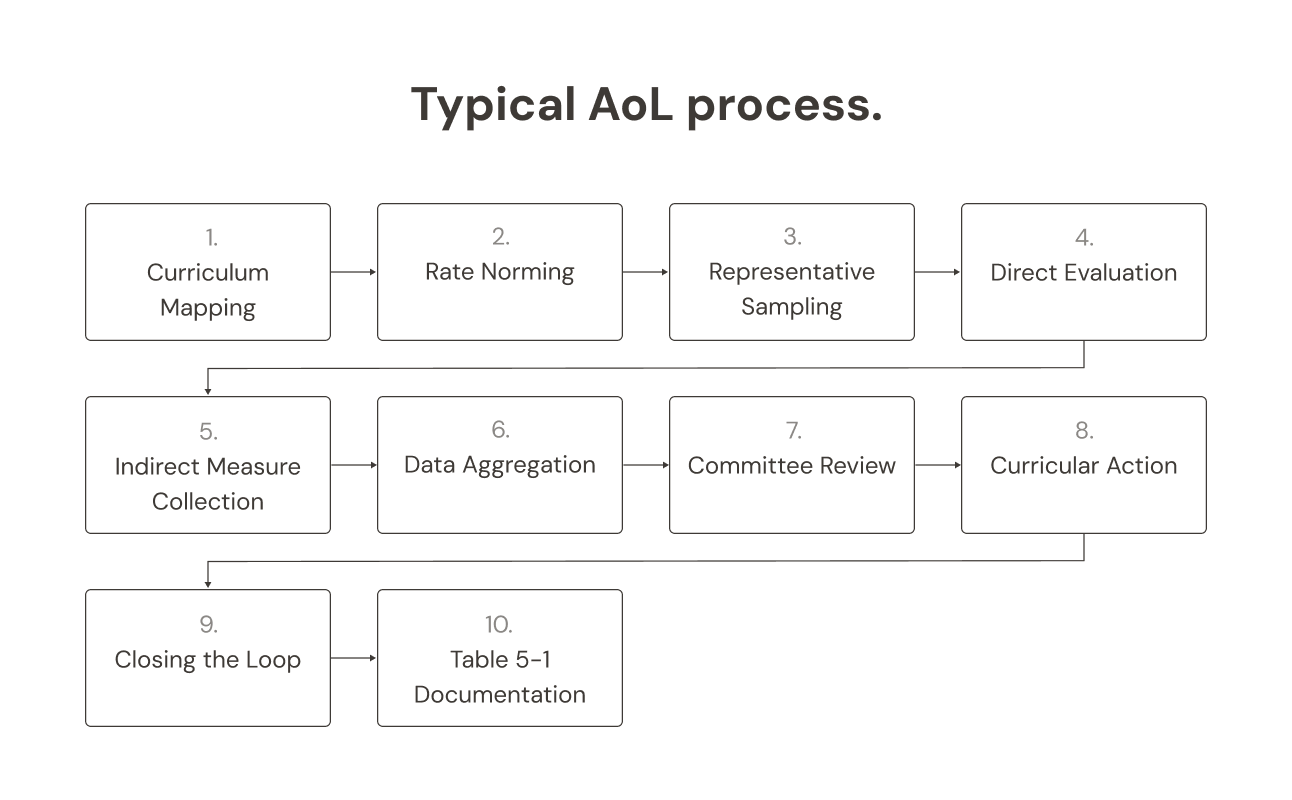
One observation quickly became clear: participants saw the greatest potential for agentic AI in the second stage of the process—rater norming. Which primarily indicates the rating unevenness across faculty while scoring artifacts.
While AI can never be a replacement for a faculty member grading the rubric, there is context to the grading process that an AI as of today can never understand, whether it's how the curriculum was delivered, or how the curriculum changed before a course was phased into the semester, which led to a difference in learning outcomes. All of this is still out of scope.
However, what AI is specifically good at is creating a baseline evaluation, which ensures there is consistency in grading.
If five faculty members apply a rubric to student work and each applies it slightly differently, then there is a calibration problem. An AI system doesn't drift between graders, and human spot-checks can confirm reliability without re-doing every score by hand.
Faculty Oversight is Non-Negotiable
One thing the room was very clear on is that faculty oversight is not optional. AACSB allows AI to be used across many steps of the process, as long as faculty review and approve the outcomes, and that requirement doesn't go away.
One participant also pointed out that a process which looks too automated can fail the "smell test" with a review team, even if the outputs are good.
What's also interesting is that oversight tends to erode over time. As people build trust in a system, the review gets lighter pass over pass. It's not a flaw in any one person, it's just a very human pattern, and it's something any workflow has to be designed against from the start.
Data Privacy as a Primary Hurdle for AI Adoption
Prior to our roundtable, we also asked the participants to fill out a survey, and one of the questions was about the biggest hurdle they foresee in adopting AI.
And rightly so. Handling student data is extremely sensitive. Sensitive data such as student names, IDs, and grades are all things that faculty may be hesitant to upload to a cloud-based service such as ChatGPT or Claude.
That's why AI shouldn't be adopted without being mindful of the risks. It also means adopting technologies that are specifically FERPA-compliant and aligned with institutional data privacy frameworks, while building workflows that keep all the right guardrails in mind for how the infrastructure handles that data.
But compliance is really just the floor.
The harder questions sit above it: Who holds the vendor contract, and what does it say about data use? Where is student data actually stored, and in which jurisdiction? Is there any possibility the model is being retrained on institutional inputs? Who inside the institution has access to query logs, and who audits that access?
These are data governance questions, and most institutions haven't had to ask them this rigorously until now. AI is forcing that conversation whether schools are ready for it or not.
Where We’re Headed
Through our conversation, it was clear that there's a real fit for AI in the workflow of AoL.
The key question now is where to focus: identifying which parts of the process AI can genuinely strengthen, and which are better handled without it. That's the calibration: understanding each institution's specific needs, how they handle data internally, and at what stage AI can add the most value.
In our next session on July 28, we'll move from theory to practice by demonstrating of how to design an agentic workflow within the AoL process. If you work in AoL and and this resonated with you, we'd love to have you join the conversation.
Registration details to follow.