
There’s a particular kind of work in higher education that almost nobody outside it has heard of, and the people inside it tend to talk about in tired, slightly resigned tones (oftentimes vocal about the burdens of extensive paperwork).
It goes by different names depending on which accreditor your particular department/school answers to. Assurance of Learning if you're in a business school. Outcomes assessment if you're in engineering. Competency-based programmatic review in the health professions. The vocabulary changes; but the work doesn't. You define what students are supposed to learn, you collect evidence that they actually learned it, and every few years you prove to an accrediting body that you've documented the whole process meticulously, often rigorously and as accurately as possible.
On paper it’s straightforward. In practice, the task is much more complicated than it looks —and the work falls disproportionately on a small number of people in each program outside their formal work duties.
Why we started writing
The starting point was something narrower than a blog. We were running a proof-of-concept study with Claremont Graduate University’s AI for Humanity Lab, exploring whether AI could meaningfully support rubric-based competency evaluation—the kind of scoring work that sits at the center of most accreditation cycles.
At first, it was a research question: can an LLM model help here, and where does it fail?
We started Aolia because we kept finding ourselves in conversations with assessment directors, program coordinators and associate deans across different institutions, and noticing how similar their pain points were — and how rarely they had a space to compare notes.
So this is an attempt to change that: a community of practice for people inside accreditation, built by people who’ve spent time listening carefully to what the work actually looks like from the inside.
What we'll be writing about
Some of them will be about AI, because that question is unavoidable now and most of the writing on it is either too optimistic or too dismissive to be useful.
Most of the posts will be not be about AI directly.
It will be about the administrative burden problem. What reviewers actually look for. Why so much assessment data never makes it back into curriculum decisions.
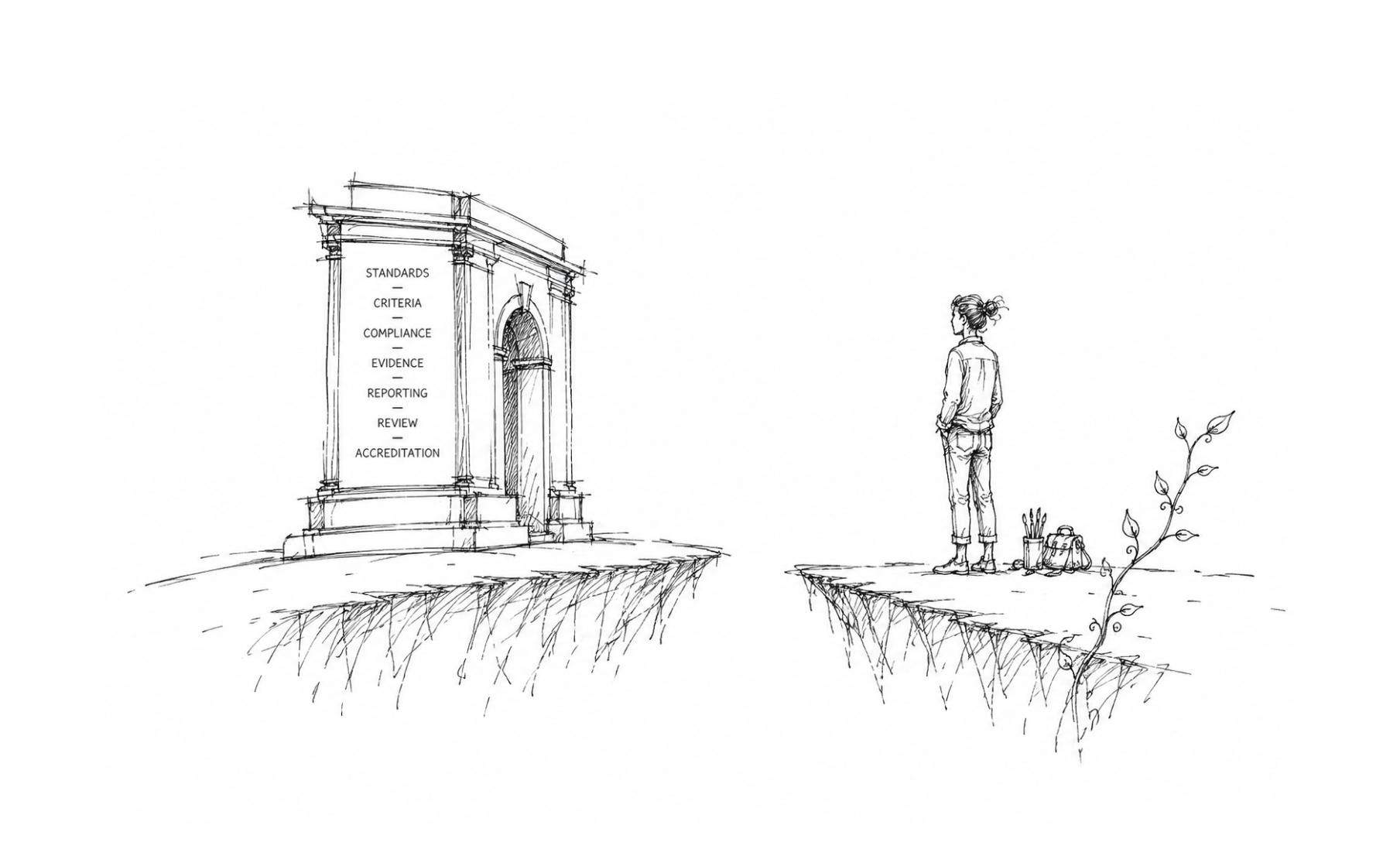
It’s about the gap between what accreditation asks programs to demonstrate and the infrastructure they’re actually given to demonstrate it with.
If you’ve ever felt that gap personally, you’ll recognize it.
Beyond the writing
That listening turned into something more structured this year, starting with conversations across the AACSB community. We started the AoL Roundtable, a small, invite-only series where Assurance of Learning (AoL) directors, faculty, and deans get hands-on with Agentic AI, exploring how it can be applied within their own institutions workflows.
As the series runs, we’ll be publishing what comes out of it here, alongside what we’re learning from the research side.
Before you go
If you have a few seconds, we'd genuinely like to hear this: where in your assessment or accreditation cycle does the process feel least supported?
If something is slow, manual, duplicated, or quietly held together by workarounds—we’re especially interested in that.
Hit reply and tell us what you work on and what you wish someone would take seriously. Much of what we publish here will come from those conversations, and we read every response.
Glad you’re here. We’re looking forward to building this with you.