


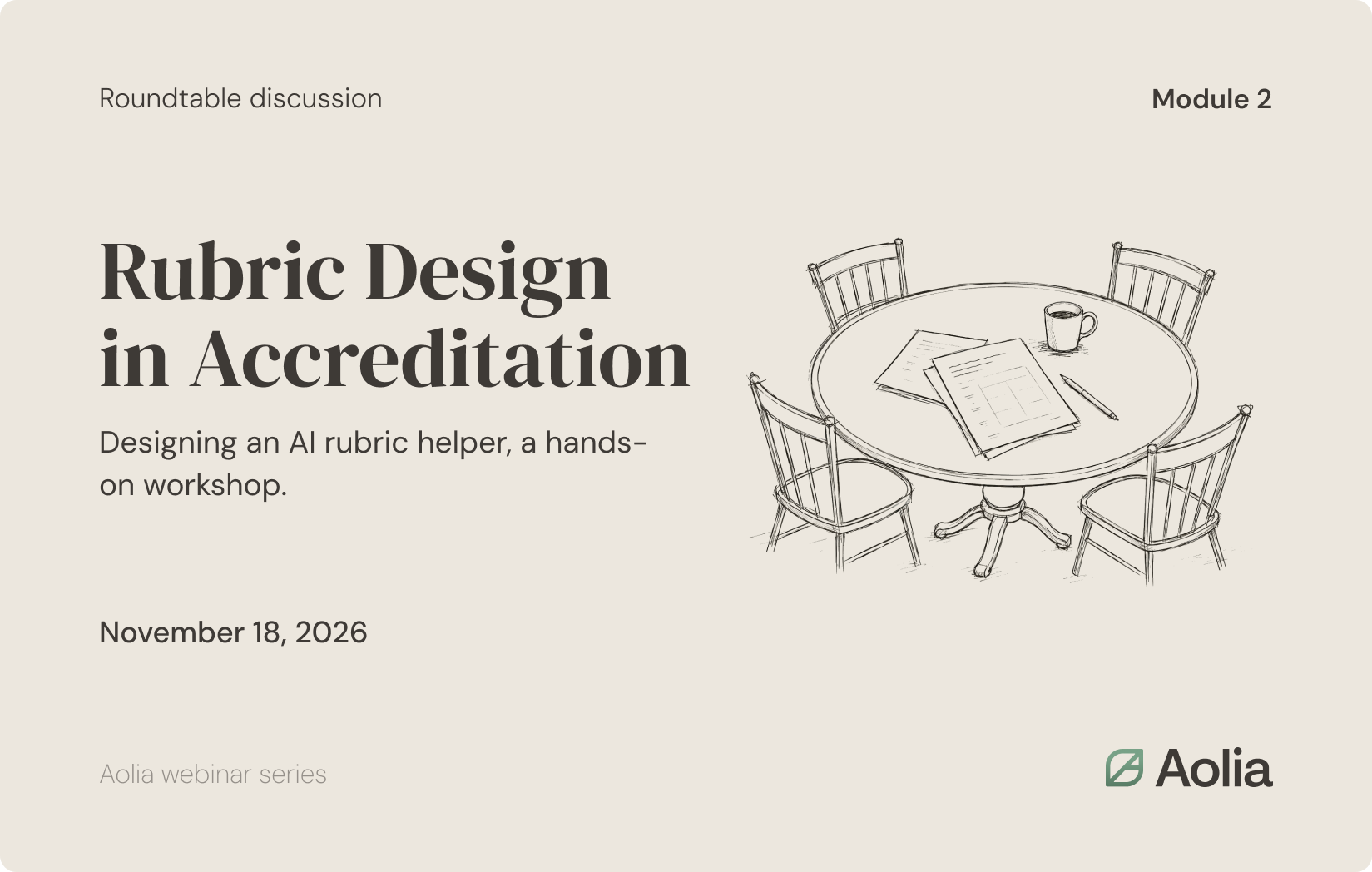
Session Details:
Date & Time: Wednesday, November 18 · 10:00–11:00 AM PT
Who It’s For: Deans, AoL directors, assessment leaders, and faculty at AACSB-accredited business schools.
What We Are Exploring
In Module 1, we looked at where rubrics tend to break down in Assurance of Learning: vague criteria, items that test two things at once, and criteria that no collected artifact can show. Participants agreed that most of these problems can be caught before data collection, yet few committees have a step for checking the rubric before scoring begins.
In this Module 2, we’ll build that step together. We’ll design a rubric helper using AI, give it the context it needs, and test how well it flags issues in a draft rubric, while faculty keep the final say on every change.
What We’ll Cover
We’ll work through a sample rubric alongside the program learning outcomes and assignments it is meant to measure. Together, we’ll set up the helper, review what it flags, and decide which suggestions hold up. Participants are welcome to bring a rubric of their own to stress-test, with any student information removed.
Together, we’ll consider questions such as:
What context does an AI helper need to review a rubric well?
Which rubric issues can it reliably flag, and which does it miss?
How should faculty review, accept or reject its suggestions, and how can those decisions be documented for the AoL report?
Facilitators
Daisuke (Dai) Nishimura, Product Manager, Macnica
Dolma Rawat, Research Lead, Macnica
About the Roundtable Discussion
Our roundtables are practitioner-led discussions built to explore emerging questions around AI and accreditation. They’re intended as a space for shared learning, thoughtful discussion, and exchanging perspectives across institutions.
Interested in Participating?
If this topic resonates with you and you’d like to take part in this roundtable or future ones, we’d love to hear from you. You don’t need to have joined Module 1 to participate.
Register using the button below. If you have any questions, reply to this post or get in touch. We’re always looking to bring new perspectives into the discussion.